

Starting a small business, often from the comfort of a home office like the one pictured here, is a significant achievement. However, the true challenge and excitement lie in taking that established foundation and scaling it. Sustainable growth doesn’t happen by accident; it requires a deliberate, strategic approach. Whether you are operating a “Global Freelance Platform” or a local service, these proven small business growth strategies can help you expand your market share and increase profitability.
The Foundation: Define Your Growth Objective
Before implementing any specific tactic, you must define what “growth” looks like for your specific venture. Are you seeking to increase revenue by 50%? Do you want to double your client base? Are you looking to expand into new geographical regions?
A vague goal of “getting bigger” will not suffice. Use the SMART criteria (Specific, Measurable, Achievable, Relevant, Time-bound). With a defined objective, your choice of the following strategies becomes clear.
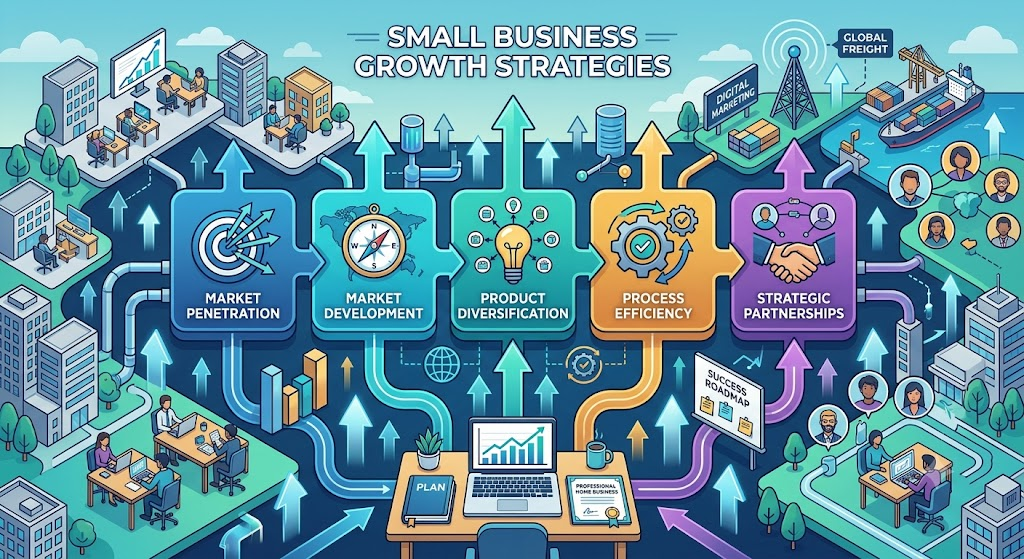
Strategy 1: Market Penetration (Sell More to Existing Customers)
This is often the safest and most efficient growth strategy. Market penetration focuses on increasing your sales of existing products or services within your current market. Because you already have a relationship with these customers, the cost of acquisition is zero.
- Implement a Loyalty Program: Reward repeat customers with discounts, early access, or exclusive offers.
- Upselling and Cross-selling: If a client uses your basic bookkeeping service, offer them a premium financial analysis package. If they buy one handmade craft, suggest a complementary item.
- Optimize Pricing: Small, strategic price adjustments can significantly affect the bottom line, but ensure your value proposition supports the change.
Strategy 2: Market Development (Find New Markets for Existing Products)
If you have a strong product but have saturated your current customer base, it’s time to find new customers. Market development involves taking what you already sell and introducing it to a new audience.
- Geographical Expansion: If your business is purely digital, look to expand to international markets (as seen on the “Global Business” laptop screen). If you are local, consider opening a second location or starting to ship products nationwide.
- New Customer Segments: If your freelance graphic design services are popular with tech startups, consider marketing them to traditional brick-and-mortar retailers.
Strategy 3: Product Development (Sell New Products to Existing Customers)
You already have the trust of your current clients; now, figure out what else you can solve for them. Product development is about innovation.
- Listen to Feedback: Analyze customer requests. If multiple clients ask, “Do you also offer X?” that is a clear indicator of a new product opportunity.
- Bundle Services: Take separate service offerings and bundle them into a comprehensive solution. This increases the perceived value and the total sale value.
- Create Digital Assets: If you run a consulting business, develop e-books or online courses based on your expertise.
Strategy 4: The Strategic Pivot or Business Model Optimization
Sometimes growth is constrained by the business model itself. To scale significantly, you might need to change how you do business. The woman in the image, managing a “Freelance Platform,” understands this.
- Move from Service to Product: Instead of trading time for money as a freelancer, create a productized service with set pricing.
- Embrace Automation: Growth often demands more time than you have. Invest in software and automation (customer relationship management, automated marketing, inventory systems) to handle the volume without burning out.
- Build a Team: You cannot scale past your own capacity. Transitioning from a sole proprietor to an agency owner involves hiring others to handle operations, allowing you to focus purely on strategy.
Step-by-Step Execution: Turning Strategy into Action
A strategy on paper is useless without execution. Here is how to implement these ideas:
- Analyze Your Resource: Growth requires capital and time. Secure your financing before launching an expansion effort.
- Test the Waters: Before launching a whole new product line, run a pilot program with a small group of trusted clients.
- Monitor Your Metrics: Define Key Performance Indicators (KPIs) for your chosen growth strategy (e.g., customer acquisition cost, conversion rate).
- Stay Customer-Obsessed: As you grow, it is easy to lose the personal touch that made you successful. Protect your customer service quality above all else.
Conclusion
Small business growth is not a straight line, but a series of deliberate choices. By carefully selecting the right strategy—whether it is squeezing more value from your current market or boldly entering new ones—you can transform your home-based venture into a global player. Start with one strategy, execute it flawlessly, and then move to the next phase of expansion.